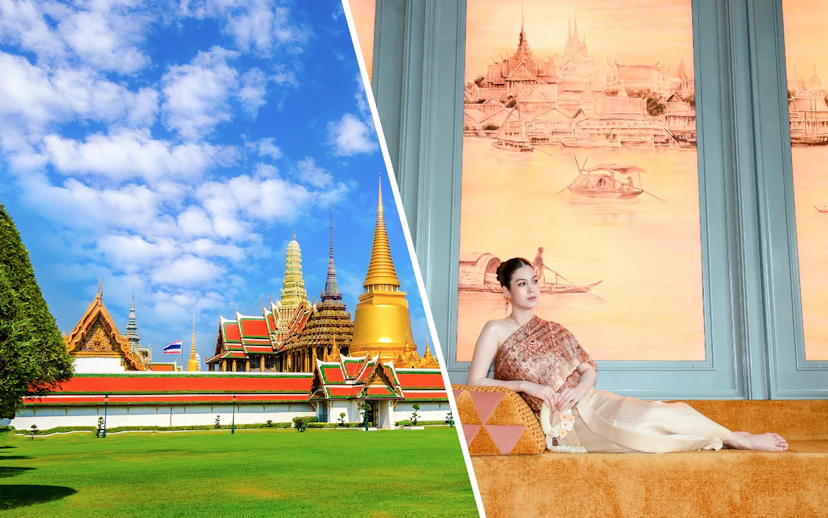
Plan your visit to The Grand Palace
The Grand Palace is Bangkok’s royal and ceremonial heart, best known for Wat Phra Kaew and the Emerald Buddha. The visit feels bigger and more demanding than many first-timers expect: it is hot, bright, mostly outdoors, and easy to rush through without a plan. The biggest difference between a frustrating visit and a rewarding one is timing — reaching the temple core before the mid-morning groups do. This guide covers the route, timing, tickets, dress code, and what to prioritize.
Quick overview: The Grand Palace at a glance
If you want the visit to feel manageable, make your key decisions before you arrive — especially timing, clothing, and whether you want context while you walk.
- When to visit: Daily, 8:30am–3:30pm. The first hour after opening is noticeably calmer than 10am–1pm, because group tours, heat, and the tight temple courtyards all peak together.
- Getting in: From ฿500 for standard entry. Audioguide rental starts around ฿200, and guided visits are most useful in peak season or if you want help understanding palace symbolism and route flow.
- How long to allow: 2–4 hours for most visitors. It stretches toward the longer end if you include the cloister murals, the textile museum, and the Khon performance.
- What most people miss: The Ramakien murals around the cloister and the Queen Sirikit Museum of Textiles both add real depth, but many visitors rush past them after seeing the Emerald Buddha.
- Is a guide worth it? Yes, if you want the site’s royal and religious symbolism explained as you go; otherwise, an audioguide is enough for a slower self-guided visit.
Jump to what you need
🕒 Where and when to go
🗓️ How much time do you need?
🎟️ Which ticket is right for you?
🗺️ Getting around
🛕 What to see
♿ Facilities and accessibility
Where and when to go
How do you get to The Grand Palace?
Address: Na Phra Lan Road, Phra Borom Maha Ratchawang, Phra Nakhon, Bangkok 10200, Thailand
- MRT: Sanam Chai Station (Blue Line) → 10–15-minute walk → Follow signs toward Sanam Luang and the palace zone.
- Ferry: Tha Chang Pier → 3–5-minute walk → The easiest option if you are arriving from the riverside or Wat Arun side.
- Taxi or rideshare: Drop-off on Na Phra Lan Road or Maharaj Road → short walk → Leave extra time because old-town traffic backs up late morning.
- Bus: Old-town routes stop near Na Phra Lan and Ratchadamnoen → short walk → Useful, but slower and less predictable than MRT plus ferry.
Which entrance should you use?
The Grand Palace is straightforward once you reach the perimeter, but the most common mistake is arriving underdressed and losing time before you even join the line.
- Pre-booked tickets or guided visits: For visitors who already have entry arranged. Expect 10–20 minutes during 10am–1pm.
- On-the-day tickets: For walk-up buyers. Expect 20–40 minutes on weekends, public holidays, and November–February mornings.
When is The Grand Palace open?
- Monday–Sunday: 8:30am–3:30pm
- Last entry: 3:30pm
When is it busiest? Late mornings, weekends, Thai holidays, and November–February are the most crowded, with the heaviest pressure around Wat Phra Kaew and the main screening area.
When should you actually go? Arrive at opening, especially Tuesday–Thursday, if you want cooler courtyards, faster entry, and a less compressed visit around the Emerald Buddha precinct.
How much time do you need?
| Visit type | Route | Duration | Walking distance | What you get |
|---|---|---|---|---|
Highlights only | Main entrance → Wat Phra Kaew → Ramakien cloister → Phra Si Rattana Chedi → exit | 1.5–2 hours | ~1.5km | You cover the site’s spiritual core and signature visuals, but skip the museum, slower courtyard stops, and most of the palace context. |
Balanced visit | Main entrance → Wat Phra Kaew → cloister murals → Phra Si Rattana Chedi → Chakri Maha Prasat courtyard → Queen Sirikit Museum of Textiles → exit | 2.5–3 hours | ~2km | This adds the palace’s royal side and one strong indoor stop, which makes the extra time feel worthwhile in both context and comfort. |
Full exploration | Full loop through the temple courts and palace courtyards → major halls exteriors → Ramakien murals → textile museum → Khon performance | 3.5–4.5 hours | ~2.5km | You get the most complete experience, but it is a hot, detail-heavy visit and stamina matters more than distance suggests. |
Which Grand Palace ticket is best for you
| Ticket type | What's included | Best for | Price range |
|---|---|---|---|
Skip-the-Line Tickets | Skip-the-line entry to The Grand Palace, access to Wat Phra Kaew, the Queen Sirikit Museum of Textiles, and a Khon dance performance at Sala Chalermkrung Royal Theatre. | Visitors who want flexible, self-paced access while avoiding the palace entry queues. | From ฿650 |
Grand Palace & Emerald Buddha Guided Walking Tour | Guided walking tour of The Grand Palace and Wat Phra Kaew with an English and Thai-speaking guide, including royal history insights and cultural context. | Travelers who want a structured route with deeper explanations of Thai royal history and architecture. | From ฿440 |
Bangkok City Highlights Guided Tour | Guided tour of The Grand Palace, Wat Arun, and Wat Pho with transfers, river shuttle, refreshments, insurance, and guide. | Visitors wanting a full cultural overview of Bangkok’s major royal and temple landmarks in one itinerary. | From ฿750 |
A half-day old-town visit where you want Bangkok’s two most important royal-temple sites linked in one route |
How do you get around The Grand Palace?
The Grand Palace on foot
The Grand Palace is best explored on foot, and most visitors need 2–3 hours for the highlights or 3.5+ hours for a fuller visit.
- Wat Phra Kaew: The spiritual core of the site and home of the Emerald Buddha → budget 30–45 minutes.
- Ramakien cloister: Painted mural corridor wrapping the temple precinct → budget 15–25 minutes.
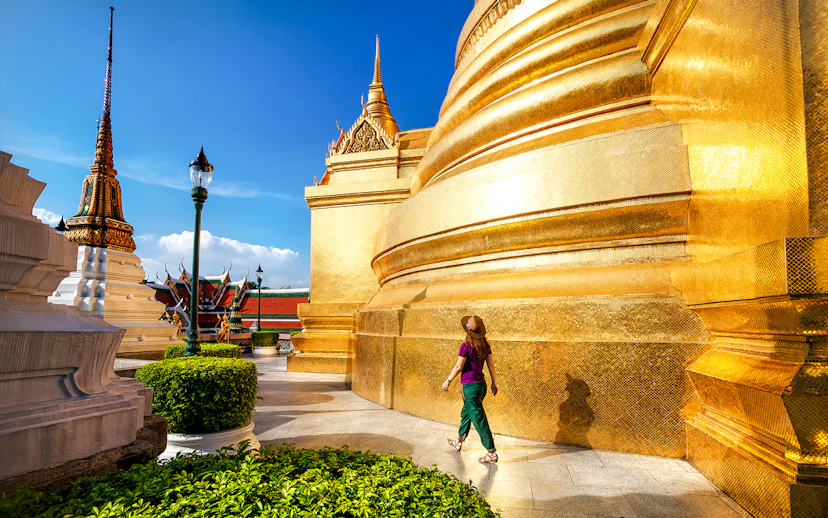
- Phra Si Rattana Chedi: Gilded stupa and one of the strongest visual anchors in the complex → budget 10 minutes.
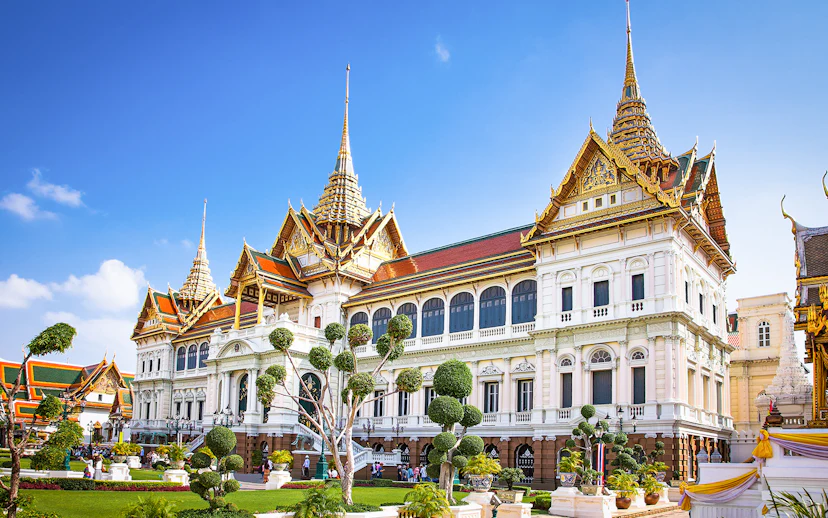
- Chakri Maha Prasat courtyard: The palace’s most striking East-meets-West facade → budget 15–20 minutes.
- Queen Sirikit Museum of Textiles: Smaller indoor museum and a useful cooling stop late in the route → budget 20–30 minutes.
Suggested route: Start with Wat Phra Kaew, then walk the cloister, circle to the chedi and guardian statues, and leave the textile museum for later when the heat builds. Most people do the reverse, which means they reach the temple core when it is already at peak crowd pressure.
Maps and navigation tools
- Map: On-site map and official visitor materials cover the main palace courts and museum areas → pick one up at entry before you start walking.
- Signage: Good enough for the main route, but not detailed enough to explain what you are seeing without a map or guide.
- Audio guide / app: Audioguide rentals are available in multiple languages and add real value if you are visiting without a guide.
💡 Pro tip: Do not save Wat Phra Kaew for the end — the route is technically flexible, but the crowd pattern is not.
What are the most significant spaces in The Grand Palace?

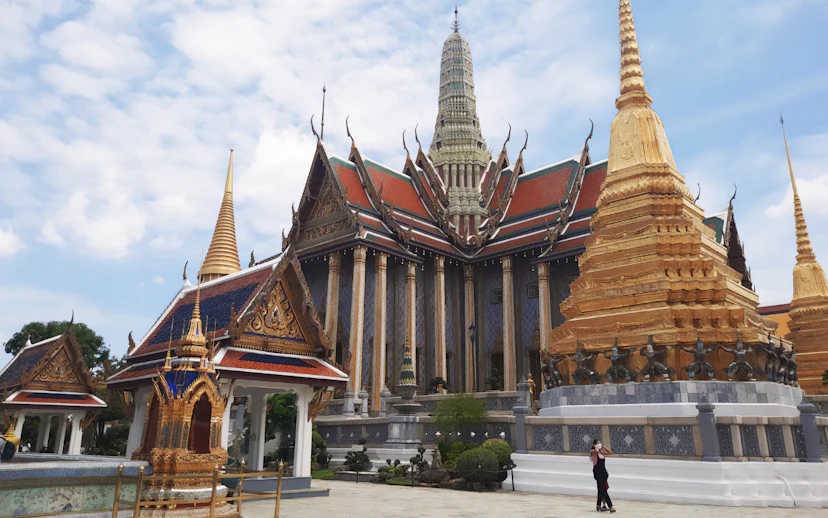
Wat Phra Kaew
Attribute — Type: Royal temple and sacred shrine
This is the spiritual center of the entire complex and the reason many visitors come in the first place. The Emerald Buddha itself is smaller than people expect, but the power of the room comes from the gold, mirrored surfaces, and the fact that this is still one of Thailand’s most revered sacred spaces. What many visitors rush past is the atmosphere around the shrine rather than the statue alone.
Where to find it: In the central temple precinct, reached soon after entering the palace complex.
Phra Si Rattana Chedi
Attribute — Type: Gilded stupa, 19th century
This bell-shaped golden stupa is one of the palace’s most photographed landmarks, and it works as a visual anchor when the complex starts to feel overwhelming. It is worth slowing down for the details in the surface work, not just the shine from a distance. Many visitors photograph it once and keep moving without noticing how it frames the surrounding temple buildings.
Where to find it: Inside the Wat Phra Kaew precinct, near the core cluster of ceremonial buildings.
Chakri Maha Prasat Throne Hall
Attribute — Type: Throne hall, 1877
This is the palace building that best shows how the site evolved beyond a purely traditional temple complex. Its lower European-style facade and upper Thai spires create one of the most unusual silhouettes in Bangkok. Many visitors only shoot it from the front, but the contrast becomes clearer when you pause long enough to read the building as a hybrid, not a contradiction.
Where to find it: In the palace court beyond the temple core, along the main visitor circulation route.
Ramakien murals
Attribute — Type: Narrative mural cycle
The long cloister murals tell Thailand’s national epic in 178 panels and are one of the richest parts of the visit if you give them time. They also create a slower, shaded counterpoint to the bright courtyards outside. Most visitors glance at one or two scenes and move on, missing the scale of the story and the fine gold detailing worked into the paintings.
Where to find it: Along the covered cloister that loops around the Wat Phra Kaew precinct.
Yaksha guardian statues
Attribute — Type: Mythic guardian figures
These giant demon guardians are more than photo props — they mark thresholds and bring the Ramakien world into the architecture itself. Their scale helps children and first-time visitors read the palace as a place of ritual drama, not just ornament. What many people miss is that the guardians differ in color, posture, and identity rather than repeating the same figure.
Where to find it: At major gateways and approach points around the temple and palace entrances.
Queen Sirikit Museum of Textiles
Attribute — Type: Museum collection
This small museum is easy to skip because it is quieter and less visually overwhelming than the temple precinct, but that is exactly why it helps. It gives you royal context, ceremonial dress history, and a break from the heat without feeling like filler. Many visitors never realize it is included in the same ticket and walk straight past one of the most comfortable parts of the route.
Where to find it: Within the palace grounds, off the main courtyard route after the core temple visit.
Facilities and accessibility
- 🎧 Audioguide counter: Audioguides are available for about ฿200 and are useful if you want context without committing to a guided group.
- 👗 Dress cover loans: Cover-ups are usually available at the entrance if your outfit does not meet the palace dress code, but needing one will slow your entry.
- 🏛️ Queen Sirikit Museum of Textiles: This museum is included with admission and gives you a quieter, air-conditioned stop during a mostly outdoor visit.
- 🎭 Khon performance access: Your ticket also includes the Khon dance performance, so keep your same-day admission ticket with you if you plan to go.
- 🧾 Single-ticket access: One paid entry covers the palace complex, Wat Phra Kaew, and the included museum components, which makes route planning simpler than the scale suggests.
- ♿ Mobility: The main courtyards and many exterior paths are broad and manageable, but some halls, thresholds, and raised areas still involve steps, so accessibility is partial rather than fully step-free.
- 👁️ Visual impairments: The audioguide is the most helpful support because much of the site’s meaning is in visual detail and ceremonial context rather than large interpretive displays.
- 🧠 Cognitive and sensory needs: Arriving at opening helps most if crowds feel overwhelming, because the entrance area and Wat Phra Kaew become much denser from about 10am onward.
- 👨👩👧 Families and strollers: Strollers can handle much of the main paved route, but a lightweight foldable stroller is easier than a bulky one once the site fills up.
The Grand Palace works well with children if you keep expectations realistic — it is visually dramatic and full of giant guardians and gold detail, but the heat and dress rules make pacing important.
- 🕐 Time: Around 2–2.5 hours is realistic with younger children if you focus on Wat Phra Kaew, the guardian statues, and one slower museum stop.
- 🏠 Facilities: The cloistered mural walk and the textile museum are the easiest parts of the visit for a short reset out of direct sun.
- 💡 Engagement: Turn the visit into a spot-the-details game by looking for yaksha guardians, gold spires, and the Angkor Wat model.
- 🎒 Logistics: Bring water, hats, and fully dress-code-compliant clothing from the start so you are not fixing outfits at the gate with tired kids.
- 📍 After your visit: Wat Pho is the easiest child-friendly second stop nearby because the walk is short and the reclining Buddha feels immediately different.
Rules and restrictions
What you need to know before you go
- Entry requirement: Foreign visitors need a valid paid ticket, while Thai nationals can enter free with Thai ID.
- Booking method: Walk-up tickets are available, but pre-booking or joining a guided visit saves time in high season and on busy mornings.
- Bag policy: A small day bag is the easiest option because security is faster and the site is crowded enough that larger luggage quickly becomes annoying.
- Re-entry policy: Re-entry is generally not allowed once you leave, so plan your full route, breaks, and meals as one continuous visit.
Not allowed
- 🚫 Food and drink: Eating inside the sacred core is restricted, so finish snacks before entry and treat the visit as a proper temple stop.
- 🚬 Smoking and vaping: Smoking and vaping are not allowed inside the palace complex.
- 🐾 Pets: Pets are not allowed inside the complex, aside from service-animal accommodations where applicable.
- 🖐️ Touching or climbing: Do not touch sacred objects, lean on decorated surfaces, or climb for photos because the site is ceremonial as well as historic.
Photography
Photography is generally allowed in the outdoor courtyards and around the palace buildings, but rules are stricter in sacred interiors. The key distinction is the Emerald Buddha temple area, where indoor photography is not permitted. Flash, tripods, and bulky photo setups are best avoided in restricted or crowded spaces, even where general photography is allowed.
Dress code
The Grand Palace enforces a dress code at all times for entry to the temple and palace complex. Entry will be refused if the requirements below are not met.
Required:
- Shoulders must be covered
- Knees must be covered
- Avoid see-through, very tight, or ripped clothing
Good to know: Cover-ups may be available at the entrance, but borrowing them adds time and is a poor substitute for arriving properly dressed.
⚠️ Dress code is enforced at the entrance with no exceptions. Shorts and sleeveless tops are the most common reason visitors lose time or get turned away.
Good to know
- Palace-closed scam: If someone outside says the palace is closed and offers you a tuk-tuk tour instead, ignore them and check the entrance yourself.
- Temple etiquette: Even when the site feels like a landmark, you are still in an active sacred space, so behavior matters as much as clothing.
Practical tips
- Booking and arrival: In November–February, aim to arrive 30–45 minutes before opening or book ahead, because the quietest part of the day is short and the lines build quickly after 10am.
- Pacing: Go straight to Wat Phra Kaew first, then do the cloister and palace courts; if you leave the temple core until later, you will hit it at the most crowded point of the day.
- Crowd management: Tuesday–Thursday mornings are usually smoother than weekends because the entrance bottleneck, group tours, and photo stops all stack up late morning.
- What to bring or leave behind: Bring a small bag, sun protection, and full-length temple-appropriate clothing; this is an open-air visit, and borrowed cover-ups are useful but slow.
- Food and drink: Eat before you go in or wait until you are done, because this is not a site that rewards stepping out halfway through and trying to come back.
- Comfort: Save the textile museum or the Khon performance for later in the route when the heat peaks, because they act as natural cooling breaks in a mostly outdoor visit.
What else is worth visiting nearby?
Commonly paired: Wat Pho
Distance: 450m — 5–7 minutes on foot
Why people combine them: It is the easiest same-day pairing in old Bangkok: royal history first, then the Reclining Buddha and temple grounds without needing transport.
Book / Learn more
Commonly paired: Wat Arun
Distance: About 1.3km including ferry transfer — 15–20 minutes total
Why people combine them: The pairing gives you Bangkok’s two strongest historic riverfront icons in one day, and Wat Arun feels visually different enough that it does not blur into the palace visit.
Also nearby
Bangkok National Museum
Distance: About 900m — 10–12 minutes on foot
Worth knowing: This is the best nearby stop if the palace leaves you wanting more historical context rather than another temple.
Museum Siam
Distance: About 1.4km — 15–18 minutes on foot
Worth knowing: It is more interactive and lighter in tone, which makes it a good second stop if you want a break from ceremonial architecture.
Eat, shop and stay near The Grand Palace
- On-site: There is no standout sit-down meal inside the core complex, so eating before entry or after you finish is the better plan.
- Tha Maharaj (10-minute walk, 1 Maharaj Rd): Riverside dining complex with multiple casual options, useful when your group wants choice more than a destination meal.
- The Sixth 6th (8-minute walk, 327 Maharaj Rd): Casual Thai food at mid-range prices, good for a quick lunch that still feels local.
- Err Urban Rustic Thai (12-minute walk, 394/35 Maharaj Rd): A stronger sit-down option if you want a proper post-visit meal rather than a convenience stop.
- 💡 Pro tip: Eat after the palace, not before 11:30am nearby, if you want to avoid both the late-morning palace crush and the lunch rush around Maharaj Road.
- Grand Palace souvenir shops: Basic postcards, temple keepsakes, and small gifts near the exit, best if convenience matters more than originality.
- Tha Maharaj retail arcade: Small riverside gift and design stores that are calmer and more comfortable than buying the first souvenir you see outside the gate.
This area is a strong short-stay base if your priority is old Bangkok, riverside views, and walkable access to the city’s ceremonial core. It is quieter at night than newer districts, but it is also less convenient for late-night dining, shopping, and cross-city transit. Stay here if you want atmosphere over citywide convenience.
- Price point: Mostly mid-range to upscale riverside stays, with fewer budget choices than Sukhumvit or Siam.
- Best for: Short trips focused on temples, museums, and early starts in the old city without needing taxis first thing in the morning.
- Consider instead: Riverside hotels farther south work better if you want boat access and more dining, while Siam or Sukhumvit suit longer stays that mix sightseeing with nightlife and easier transit.
Frequently asked questions about visiting The Grand Palace
Most visits take 2–4 hours. If you only want Wat Phra Kaew and the core courtyards, 1.5–2 hours can work, but the route feels much more complete if you allow time for the Ramakien murals, Chakri Maha Prasat, and the textile museum.
No, but booking ahead is worth it in high season and on busy mornings. Walk-up entry is possible, yet November–February weekends and holiday periods are when pre-booking saves the most time and uncertainty.
Yes, it can be worth it when crowds are heavy, especially if you are visiting between 10am and 1pm. The biggest value is not just shaving queue time, but getting into the temple core before the site feels compressed and overheated.
Arrive at least 20–30 minutes early. That gives you enough time for security, dress-code checks, and finding the right line without burning the best part of the morning once the site opens up.
Yes, a small backpack or day bag is usually fine. Large bags make security slower and are awkward in a crowded, ceremonial site, so lighter is better here than it is at many open-air attractions.
Yes, photography is allowed in most outdoor palace areas. The main restriction is inside the Emerald Buddha temple, where indoor photography is not permitted, so do not assume the entire complex follows one blanket rule.
Yes, and many people do. The main issue is not whether groups are allowed, but that late-morning group arrivals make the narrowest parts of the route feel much busier than the open courtyards suggest.
Yes, if you plan for heat, clothing rules, and realistic pacing. Children usually respond well to the guardian statues, gold spires, and open courtyards, but the visit works best when you keep it under about 2.5 hours with younger kids.
It is partly accessible, not fully step-free. The main exterior routes and courtyards are manageable, but some halls, raised thresholds, and ceremonial structures still involve steps or limited access.
Yes, but the better options are near the palace rather than in the core visit route itself. Tha Maharaj and nearby Maharaj Road restaurants are the easiest post-visit choices once you leave the complex.
Wear clothing that covers your shoulders and knees. This is one of the few Bangkok attractions where dress code is actively enforced, so do not treat it like flexible temple etiquette and hope to sort it out at the gate.
Buy from the official counter, the official site, or a verified booking partner. Ignore anyone outside the entrance saying the palace is closed or trying to redirect you to another tour, because that scam is still common in this part of Bangkok.